
 4 min
4 min
Lucky and Loquacious
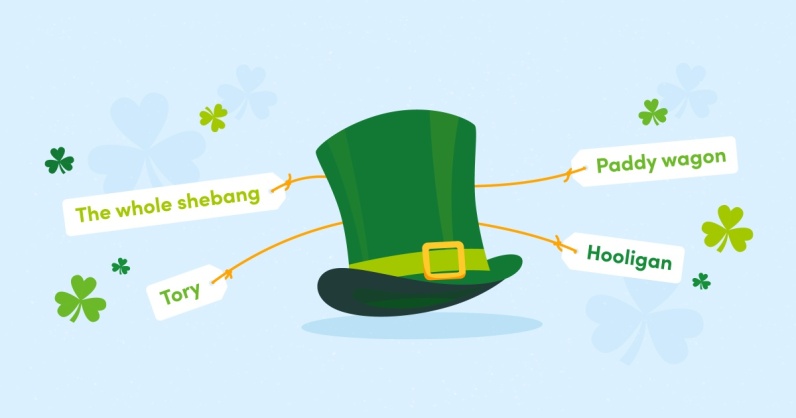
Whenever Saint Patrick’s Day rolls around, a lot of us seem to suddenly remember having some kind of Irish ancestry to celebrate. While such claims to be kissably Irish may often be debatable, nobody can deny that speakers of English have Irish roots in our linguistic DNA. This Word Stories instalment pays homage to the ways in which our everyday speech has been shaped by Irish history.
paddy wagon
In informal idiomatic English, a paddy wagon is a van used by the police to move officers or detainees around. The paddy part of paddy wagon seems to be based on the Irish nickname Paddy (short for Patrick)—perhaps due to cultural stereotypes of Irish people being unruly, or perhaps because Irish-American families once swelled the ranks of police departments in the large northeastern cities of the United States. One dissenting theory suggests that paddy wagon is instead a colloquial truncation of patrol wagon, but patrol cars have never been comparably nicknamed paddy cars, and the association of Irish people with paddy wagons actually predates the automobile industry.
Thanks to the British English perception that poor Irish farmers were reduced to using wheelbarrows in place of proper wagons, paddy wagon was a popular 19th-century slang term for a “wheelbarrow” (The Milwaukee Daily Sentinel, November 8, 1868). It was only in the 20th century—in the wake of the waves of young men from Irish-American immigrant families who became police officers—that the derisive name paddy wagon was transferred to the motorized vehicles such officers might use to transport people they arrested (The Chicago Tribune, September 12, 1909). In everyday modern English, this recent urban sense of the term is the only one that survives.
hooligan
In idiomatic English, a hooligan is usually an unruly young man—most often in the context of discussing frenzied sports fans, public mischief or gang violence. The term seems to be rooted in stereotypes of Irish rowdiness and criminality. In the London of the 1800s, the Irish family name Hoolihan (rendered as Hooligan or O’Hooligan) became a catch-all term evoking Irish people in general, in comedic songs, plays and newspaper comic strips (H. Shore, London’s Criminal Underworlds c. 1720–c. 1930: A Social and Cultural History, 2015). In the 1890s, some disenfranchised London youths with Irish backgrounds seem to have adopted the put-down as an outsider badge of honour by forming a gang variously called the Hooligan Boys (The Sheffield Evening Telegraph and Star, April 24, 1894) or the Hooligan Gang (The Nottingham Evening Post, August 7, 1894).
The Hooligan Gang caught the public’s attention to the point that street gangs of any kind were soon referred to by extension as “Hooligan gangs” (The Daily News, July 26, 1898) and the word Hooliganism was coined to describe the social problems of unruly young people and thuggish behaviour in general (The Scottish Evening Telegraph, October 3, 1898). It wasn’t long before any criminal lowlife might be called a Hooligan (The Pall Mall Magazine, February 1901), and from there the word drifted ever further away from its historical associations with one particular London street gang of the late 1800s. This trend is evident, for example, in the way English sources from the 20th century onwards tend to use the much more generic, uncapitalized forms hooligan (H. Walpole, The Fortress, 1931) and hooliganism (The Catholic Times, September 1, 1911).
Tory
Tory is a borrowing of the Irish tóraighe meaning “outlaw” or “hunted man” (from the Old Irish tóirighim “I chase”). Tóraighe is attested in 16th-century English and referred to Irish bandits, some of whom had strong grievances against the English, and later British, governments. By the mid-17th century, it referred more generally to angry Irish Catholics dispossessed of their land. Then in the 1680s, there was a political conflict over the succession of the heir presumptive to the throne, the Duke of York, who was the brother of the newly deceased Charles II and who had converted to Catholicism in the 1660s. An Exclusion Bill was proposed to prevent the Duke of York’s succession after Charles II’s death, and Parliament was dissolved several times to prevent this. Anti-Catholic supporters of the Exclusion Bill referred to the Duke of York’s supporters with the offensive and hyperbolic epithet tóraighe, Anglicized to tory. Somewhat ironically, Tories was soon reclaimed as a positive or neutral term for Yorkists, and later, given the word’s origins, to conservative supporters of the British monarchy in general (e.g. the Loyalists in the American colonies). Eventually the term was replaced as a party name by Conservatives, but it has remained as a colloquial synonym up to the present day in various English-speaking countries.
the whole shebang
Akin in both phrasing and meaning to expressions like the whole nine yards or the whole kit and caboodle, the whole shebang is an informal and often comical way of saying “everything in question”—whether that “everything” be composed of concrete or abstract things. The word shebang, used alone, is first attested around the 1870s in US slang with the sense “hut, shed, dwelling”, typically an unlicensed and poorly maintained tavern selling liquor illicitly. (In this sense, it can be compared with another Americanism, appearing a decade or two later: the speakeasy of Prohibition fame.) Shebang, probably an alteration of an earlier shebeen, appears to be from an Irish Gaelic word for the same concept. In Irish, síbín or séibín is a diminutive form (thanks to the suffix -ín) of the noun séibe, meaning “a small vessel, like a mug, or its liquid content” (N. Ó Dónaill, Foclóir Gaeilge-Béarla [Irish–English Dictionary], 1977). If this theory holds, a name for drinks or drinking vessels would have been applied metonymically to that of the establishment selling them. Such semantic shifts between the container and the contained are not uncommon.
At the end of the 19th century, a “shebang” or “whole shebang” could also be the name of a large vehicle, like a carriage, a boat or, in the 20th century, a recreational vehicle (as spoken by the character of Schmidt in A. Payne’s About Schmidt, with Jack Nicholson). The American humorist George Wilbur Peck uses the term in this way, in writing about the joys and sorrows (mostly the latter) of iceboating in Madison, Wisconsin:
In about a minute the boat neared the opposite shore, and we proposed to dismount, but before we could think a second time the whole shebang had gone up among the trees, and was trying to climb up one of them […]. We sat, thinking of some way to kill off the man who invented ice boats.
Source: George Wilbur Peck, Peck’s Fun: Being Extracts from the La Crosse Sun and Peck’s Sun, Milwaukee, 1879
Gradually, the whole shebang came to be used in ever more general terms, until it took on its current meaning of “any big thing or collection of things”.