 7 min
7 min
Defining Moments
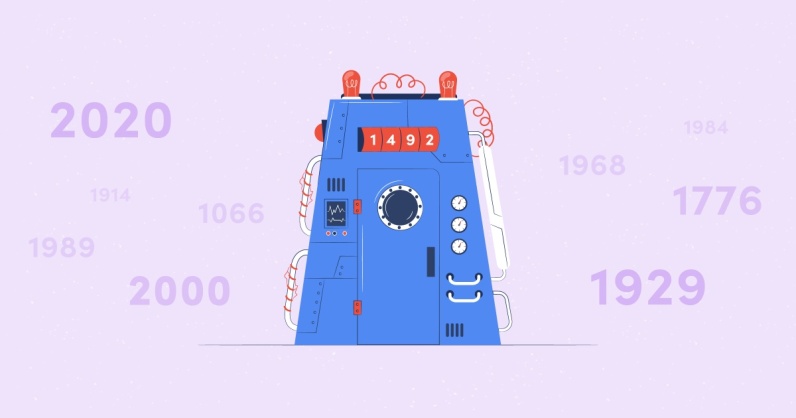
Some years seem to blur together, while others are marked by a jolt of activity that sets them apart and changes the course of history. This brings to mind the saying “There are decades where nothing happens, and there are weeks where decades happen.” While many historical events have a specific name—like D-Day—others can be referred to simply by the year in which they occurred. Years like 1492 and 2001 become idiomatic in their own right, often used without a gloss—that is, an explanation of what they signify. This article looks at these symbolically potent years in English, along with tips on how to write and say them.
First, let’s name this phenomenon. The use of dates to stand in for events is part of a wider literary device known as metonymy, where an attribute for an entity replaces the literal word for that entity. For example, you can use the crown to refer to a monarch.
There are countless years that hold historically significant events, but the following years are the most recognizable to a mainstream English-speaking audience when used without further explanation. Antidote’s linguists compiled this list by consulting historian-curated lists of significant dates and then checking corpus evidence to identify which years are most often used metonymically, i.e. as shorthand for the events they denote.
Key Dates in the English-speaking World
1066
A defining moment in British history, this year began with the death of the king, setting off a period of turmoil in the absence of a clear successor. It culminated in the Duke of Normandy’s victory at the Battle of Hastings and the Norman Conquest of England.
[the] biggest wealth transfer from poor to rich since 1066
—The Daily Express
1492
In this year, explorer Christopher Columbus landed in the Bahamas, marking the “discovery” of the “New World”. Schoolchildren in North America are often taught a mnemonic for this year: “In 1492, Columbus sailed the ocean blue.” The American national holiday of Columbus Day commemorates this event, but many jurisdictions have shifted to celebrating Indigenous Peoples’ Day in its place.
Do you know what this country needs? A seven‐cent nickel. We’ve been using the five‐cent nickel since 1492. … So why not give the seven-cent nickel a chance?
This joke, by American comedian Groucho Marx, uses 1492 as a long-ago reference point in his parody of political rhetoric that employs both allusion to long tradition and enthusiasm for new ideas regardless of their merit. (The United States didn’t exist in 1492, and neither did the nickel, which emerged in the 19th century.)
1776
In this year of the American Revolution, the Declaration of Independence was signed. This moment is marked each year on July 4th, known as Independence Day or colloquially as the Fourth of July or simply the Fourth.
Recent news has had me feeling patriotic in a very 1776 sort of way.
—Reddit comment
The War Years
The years 1914 (start of World War I), 1939 (start of World War II) and 1945 (end of World War II and birth of the post-war order) are often used metonymically, whereas 1918 (end of World War I) is more commonly referred to as the Armistice or the armistice of 1918.
Echoes of 1914: are today’s conflicts a case of history repeating itself?
—The Guardian
I loved my trip to the Baltics. … But I have come home feeling very 1939 about the world.
—The i Paper
… party must invoke the spirit of 1945 and “harness the values that saved a nation” post-pandemic
—The Guardian
1929
The United States stock market crash, which catalyzed the Great Depression of the 1930s.
The Big Crash: Are we really heading for another 1929?
—The Telegraph
1968
A focal point of the countercultural 1960s, this year was a uniquely eventful time of social uprising and rebellion. Key moments include short-lived democratic reform in Czechoslovakia, student revolts and a general workers’ strike in France, and riots in the United States after the assassination of Martin Luther King Jr.
The spirit of 1968 is inextinguishable – even 50 years later. This rebellious era shaped radical activists – and aggressive capitalists.
—openDemocracy
1984 (as a fictional year)
The enduring popularity of George Orwell’s dystopian speculative fiction novel Nineteen Eighty-Four, published in 1949 and set in an imagined 1984, has contributed numerous expressions to English vocabulary, including Big Brother and doublethink, as well as 1984 itself as a byword for a futuristic totalitarian surveillance state.
Supreme Court Sees Shades of 1984 in Unchecked GPS Tracking
—Wired
1989
The Fall of the Berlin Wall, symbolically marking the end of the Cold War and the fall of communism in Europe.
The post-1989 world order is unraveling
—Politico Magazine
2000
This year is notable for the anticipated computer malfunction that, without intervention, would have affected computer systems that use a two-digit year format when the year changed from 1999 to 2000. This year is commonly referred to as Y2K (pronounced wigh-too-KAY), especially in phrases like the Y2K problem and the Y2K panic and when harkening to the aesthetic of the late 1990s and early 2000s.
Side Parts Really Peaked During Y2K, Didn’t They?
—The Zoe Report
2001
This year saw the September 11, 2001, terrorist attacks that set off the Global War on Terrorism. So epoch-making was the day of these attacks that it features as an entry in most modern English dictionaries, written as September 11, September 11th, or the shorthand 9/11 (pronounced “nine eleven”). These spellings take the North American month/day date format, but they are used across the English-speaking world.
Everyone remembers 9/11 — even those of us who weren’t there. We have all heard the question: “Where were you on 9/11?”
—The Collegian (Hillsdale College)
US military expenditures persisted, fuelling interventions that reshaped the post-2001 world order.
—The World Financial Review
2008
The global financial crisis, which eroded trust in markets and banks.
Something on Wall Street ‘Smells Like’ 2008, Says Former Goldman Sachs Chief.
—Investopedia
2020
This year brought the global Covid-19 pandemic—characterized by lockdowns, sweeping public health measures, and an economic crisis—and saw a reckoning on racism. The term unprecedented characterized this disruptive year, so much so that the years preceding 2020 have taken the nostalgic label of the before times.
We have moved from a pre-2008 environment where diversification worked by default, through a crisis phase where [financial] contagion appeared episodically, and into a post-2020 world where contagion is always present.
—QuantByte
Other Places, Other Customs
Of course, not every culture shares the same frames of reference for important dates. For instance, 1066 has more salience in the United Kingdom, whereas 1776 is more recognizable in the United States. Someone from outside the Anglosphere may point to a wholly different set of significant dates—think 1789 in France, 1911 in China, 1917 in Russia, 1948 in Israel/Palestine, or 2011 in Japan. Indeed, our French article on this subject, Ces dates qui font date, points out many different dates from the ones listed here.
From History to Usage
As we consider the rhetorical power of these evocative years, it’s also worth keeping in mind the conventions for writing them on the page and saying them aloud.
Spelling Years
Spell the year in numerals except when the year comes at the very beginning of a sentence, where it should be written as it is spoken; see the Saying Years section below for more details. When written as words, only the first letter should be capitalized, since it starts the sentence. Take the year 1867, for example, which is known in Canadian politics as the year of Canada’s confederation.
We should not forget the lessons of 1867.
Eighteen sixty-seven and its lessons should not be forgotten.Not *Eighteen Sixty-Seven …
There should be no hyphen between the century and the following one- or two-digit number.
Twenty twenty-seven …
Not *Twenty-twenty-seven …
The phrase the year is often written before the year in question to aid flow and clarity, but this is sometimes redundant.
Decades are written by adding an s to the first year in the decade: the 2010s. The first decade of a century is a bit different: we avoid the 1900s, the 2000s, etc. to refer to the first decade, as this is ambiguous with the whole century. Instead, you’ll more often see the first decade of the Xth century or, occasionally, the aughts or (informally) the noughties.
Years and decades are often abbreviated, especially in less formal contexts, by omitting the century and adding an apostrophe: ’67 for 1967 or the ’90s for the 1990s, although this is more common in informal writing and for years before 2000.
Unless further context is given, it is assumed the most recent instance of a given year or decade is being invoked, so ’67 would mean 1967 rather than 1867 or 2067, and ’24 would today be interpreted as 2024 rather than 1924.
Saying Years
There are a few things to keep in mind when saying year-dates out loud.
Years before 1000
Years before 1000 are often pronounced as the first digit followed by a two-digit number. So 583 is spoken as “five eighty-three”. You can also say “five hundred eighty-three” or “five hundred and eighty-three”, the latter especially in British English.
1000, 2000, etc.
Years that end in three zeros are pronounced as a four-digit number: “one thousand” and “two thousand”. Since these are easily confused with regular numbers, they are most often preceded by the phrase “the year” to reduce ambiguity.
1200, 1900, etc.
Years that end in two zeros, like 1900, are pronounced as the two-digit number for the century followed by “hundred”. So we say “nineteen hundred”, and not “one thousand nine hundred”, which is a correct pronunciation for the number 1,900 but not for the year.
1901, 1509, etc.
When the third digit ends in a zero, like 1901, an “oh” can be spoken instead of “hundred” before the final digit: we can say “nineteen oh one” or “nineteen hundred and one”; this “oh” is typical of spoken speech and found less in written language.
1910, 1745, etc.
For all other four-digit dates before the 2000s, we say the two-digit number for the century in question and then the following two-digit number. So we say “nineteen ten” and “seventeen forty-five”.
2000s
For the years after 2000, we can either say “two thousand” or “twenty” for the century. The word and is often added in British English after thousand and before the rest of the number, but this and is usually left out in American English, while usage in Canada varies.
two thousand and twenty-three
two thousand twenty-three
twenty twenty-three
For the years 2001 through 2009, when using “twenty”, an “oh” must be added before the final digit; this “oh” is typical of spoken speech and found less in written representations.
two thousand and six
two thousand six
twenty oh six
A 2019 opinion piece in the National Post shows us that the pronunciation of upcoming years was not settled at this time, and that some have strong feelings when it comes to their pronunciation:
It’s twenty-twenty [sic], not two thousand and twenty. Shame to all who say different.
–National Post
Saying Abbreviated Years
Abbreviated years and decades like ’58 and ’80s are pronounced as two-digit numbers: “fifty-eight” and “eighties”. Abbreviated years under 10 are pronounced with “oh”, as in “oh seven” for ’07. One exception is ’00, which is spoken as “two thousand”—or, more commonly, as “the year two thousand” in order to specify a year is being discussed rather than the number 2,000.
The Years We Hold On To
This trip through the ages has highlighted years that many people recognize without further explanation as representing key historical moments. It’s a reminder that words can take many forms and that history’s lessons are embedded in our language.