 3 min
3 min
[Names Pending]: From Whatsit to Explicit
When we look back at new words that entered Antidote’s dictionaries in 2025, we can see how they fit into the categories we discussed in our article on neologisms. In a nutshell, that article covers how language is constantly being innovated through cultural exchange, new social realities and developments in technology and scientific understanding. Let’s take a look at a handful of our additions:
- deinfluencer, “a social media personality who discourages consumerism”: a new social reality
- onigiri, “a Japanese dish of shaped rice wrapped in nori”: cultural exchange
- cytokine storm, “an immune response producing excess cytokines”: new medical understanding
- robots as a service, “a cloud-based subscription service to access robots”: a new technology
It’s fairly reasonable to expect that new experiences breed new terminology. However, some of our latest additions (e.g. porcupette, “a young porcupine” and leapling, “someone born on February 29th”) don’t fit any of these innovative categories. Indeed, some additions refer to things as ancient as animal existence itself, such as bacne (“acne on one’s back”) and zoomies (“a period of intense, playful running”). So, how do we get new terms for such old concepts, and why did we never name them before?
Roads Not Taken
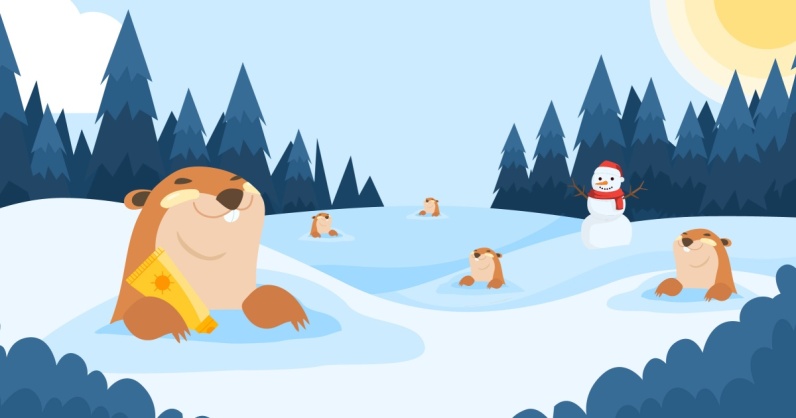
The thing is, there are (quite literally) an infinite number of concepts that could be named. It would be an inefficient use of our cognitive power to give names to them all, because we have a system of language to fill in the gaps. It is perfectly reasonable, for example, to not have a specific term for Albertan groundhogs that wear sunscreen on winter vacation because no one wants or needs to discuss this fabricated idea. (By the way, despite being completely expressible and comprehensible through the power of language, this concept has no reflection in reality—other than in this article’s illustration.)
It’s common sense to not have a lexical item for such specific or unusual concepts like those groundhogs. But there are also many everyday experiences and things that lack simple terms with which to describe them. For instance, there isn’t a simple description in English for an umbrella that has been turned inside-out by a strong wind but is still usable if you just pop it back into place. Nor is there a term that refers to a parent’s sibling without referencing gender. This lack of terminology in a language is called a lexical gap.
However, many small communities of speakers have their own private terms, such as in a friend group or family (“familect”), or even as a single person (“idiolect”). For example, for the family of this Language Matters author, the aforementioned not-quite-broken umbrella would be described as having been “tuliped”. But this word wouldn’t be recognizable among people outside of their family (although one could ascertain the meaning in the right context). So what we consider to be a “real” word or term in a particular language is one that is recognized by a broad speech community or, furthermore, codified in a dictionary.
Most neologisms start in small speech communities, whether the group be scientists, programmers, the youth or some other subset. Perhaps other families have a word for a tuliped umbrella, but none that have caught on yet with a broader community (and the Antidote lexicographers are carefully watching all the genderless words popping up for the sibling of one’s parent, such as pibling). How, then, do terms expand beyond an insular community? In short, it’s through social and cultural influence.
What Makes a Difference
Language is a part of culture, and much like every other part of culture, it is subject to trends. Culturally significant figures and objects (such as a particular song, book or website) can introduce a term to a broad audience, who then further spread the term through social contagion. Some of these trendy words are short-lived, like the (now infamous, perhaps) phrase among the youth skibidi, as initially picked up from a popular web series. Others are more enduring: Shakespeare, for example, is credited with coining—or at least popularizing—over 1000 words and phrases in the English language.1 Most of these 1000s of coinages are still used today:
- green-eyed monster from Othello (ca. 1604)
- in one fell swoop from Macbeth (ca. 1607)
- salad days from Antony and Cleopatra (ca. 1607)
- wild goose chase from Romeo and Juliet (ca. 1595)
Such influential figures like Shakespeare are one way in which we get so-called untranslatable words—terms in one language that would have to be paraphrased as a sentence when translated into another language that lacks an equivalent. For example, French has a word for “a young lady who puts on pretentious and haughty affectations”—une précieuse (often: une précieuse ridicule)—but any concise term for this is lacking in English, thus making it “untranslatable”. Presumably, English doesn’t have this word because it was popularized in Molière’s play Les Précieuses ridicules (1659) (often translated into English as The Affected Ladies) and Molière is not nearly as influential to English-speaking audiences as Shakespeare is.
In With the Old
We asked two questions in this article: why do we have (sometimes ancient) lexical gaps and why do only some unnamed concepts get names? And the answer is basically that we, as individuals, often don’t have lexical gaps for the things that matter to us, but the idiosyncratic words that we use aren’t really picked up by others all that often. But some individuals or cultural objects have such a broad audience that their unique phrasings catch on. It is through this interplay of sociolect (a form of language associated with a particular social group) and social influence that we get new terms for old realities. Case in point: the next time it rains, perhaps you’ll think of tuliped umbrellas.
-
Charlotte Brewer, “Shakespeare, Word-Coining and the OED,” Shakespeare Survey 65 (2013). ↩