
 3 min
3 min
Tempestuous Terms
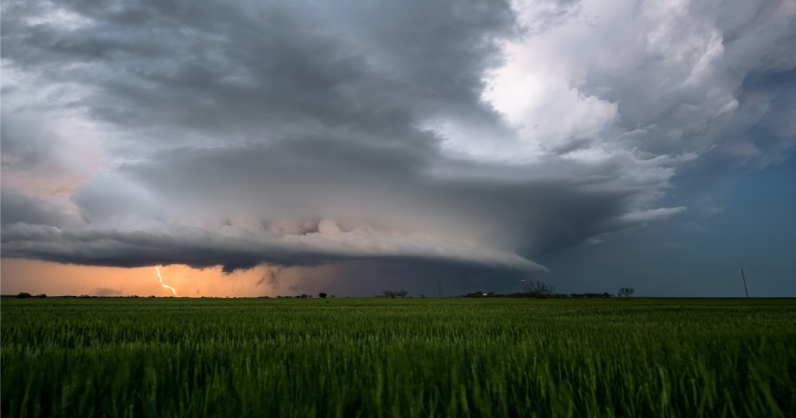
There’s something poetic about a good summer storm. In this Word Stories instalment, we curl up in the corner of linguistic creativity that thrives on bad weather.
rain cats and dogs
When people say it’s raining cats and dogs, they mean it’s raining hard. This colourful but somewhat puzzling idiom has been with us for centuries (J. Swift, Complete Collection of Genteel and Ingenious Conversation, 1738). People have tried to explain the nonsensical image in various ways. One popular origin story traces the roots of the idiom back to the ecclesiastical Greek phrase kata doxa (combining kata “against” with doxa “belief”). From this point of view, raining cats and dogs is a garbled or humorous derivative of raining kata doxa, i.e. “in a way that defies belief”. It’s an imaginative suggestion, but it doesn’t make historical sense, given the fact that the idiom’s earliest known written attestations fail to observe the cats and dogs order: they refer instead to raining “dogs and pole cats” (R. Brome, The City Wit, 1652), or simply “dogs and cats” (T. Flatman, Don Juan Lamberto, 1661).
A more gruesome theory suggests that the picture of raining cats and dogs (or dogs and cats) evokes the sorry state of public sanitation in early modern England. At the time, urban gutters were often left deplorably unattended. Torrential rains might therefore end up carrying all kinds of odd things along—including dead dogs and cats—as if they too had simply poured out of the sky. Finally, some people see it as significant that one old passage in English literature refers to people expecting thunderbolts from a big storm and getting “dog bolts and cat bolts” instead (G. Harvey, Pierce’s Supererogation, 1592). Dog bolts and cat bolts were metal components used in putting together iron gates, so maybe raining cats and dogs was originally an auditory metaphor as opposed to a visual metaphor: a particularly loud downpour might sound like the sky is raining down heavy little bits of hardware.
perfect storm
Early attestations of the phrase perfect storm in English publications are linguistically compositional in nature; that is, they simply describe the storm in question as being emphatically “real” and “intense”. Note that, etymologically speaking, the adjective perfect is synonymous with complete and completed (compare the perfect tenses, which express completed events in relation with a moment in the past or future). It is that sense that is expressed in this quote from William Makepeace Thackeray’s 1848 classic social satire Vanity Fair:
I have heard a brother of the story-telling trade, at Naples, preaching to a pack of good-for-nothing honest lazy fellows by the sea-shore […]; they and the poet together would burst out into a roar of oaths and execrations […], in the midst of a perfect storm of sympathy.
During the 20th century, actual weather storms started being described as “perfect” in the meteorological field when their fierceness and destructive power resulted from a combination of aggravating factors: encounters between low- and high-pressure systems, cold air masses, jet streams, warm water temperatures, etc. The 1991 “nor’easter” that ravaged parts of the northeastern United States and caused all crew members of the fishing boat Andrea Gail to be lost at sea was such a storm. (The incident was later the topic of a popular book and film adaptation, both titled The Perfect Storm.)
However, in recent decades, the meaning of a perfect storm has tended to become mostly metaphorical: an economic crisis, for example, may be described as a perfect storm brought about by an intersection of high unemployment rates, inflation and reckless market speculation.
steal (someone’s) thunder
When somebody steals your thunder, they’re collecting praise or credit that should probably be rightfully yours. The idiom is therefore synonymous with expressions like upstaging somebody or stealing somebody’s limelight, and, like them, it seems to have been born in the world of the theatre.
The idea of stealing someone’s thunder is traditionally traced back to an episode in the life of the English playwright John Dennis (1657–1734). According to the story, Dennis wanted to add realistic thunder sounds to his play Appius and Virginia (1709), so he built a clever sound-effects machine. Things took a bitter turn when his play got cancelled and a rival company adopted his thunder machine for their production of Macbeth. The wording of his reaction varies from report to report, but apparently Dennis made it quite clear that he was terribly offended by the way the English theatre scene had sunk his play and “stolen his thunder”. However historically accurate the theatre story may be, references to the act of stealing someone’s thunder always appear in connection with the impression of somebody being metaphorically upstaged (E. E. Peake, The Darlingtons, 1900).