 5 min
5 min
Writing and Translating in the Time of GenAI
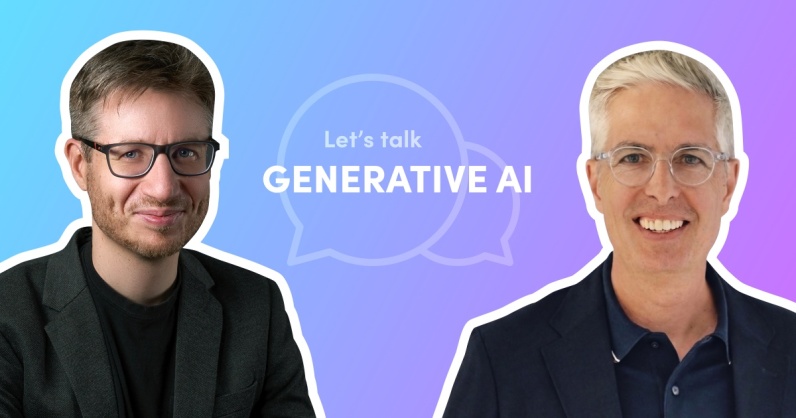
Generative artificial intelligence (GenAI) is disrupting language professions. Joachim Lépine, translator and GenAI usage expert, and Yann Fortier, copywriter and trainer, discuss the topic, describing this transformation, observing detrimental shifts and sharing their best practices.
How has GenAI transformed your lines of work?
Yann Fortier (YF): I remember the first article I read about ChatGPT in the fall of 2022. I knew then that GenAI would change the world. It has reshaped my way of approaching a text. I use it at the beginning when I am brainstorming and planning, but I fully write the texts myself. Then, I use the GenAI agent I created for revision, proofreading and fact-checking. I also use Antidote to improve and rephrase my text as needed.
In my opinion, we’re in the golden age of GenAI and Antidote converging. But we need strong writing skills to use the tools strategically and fully reap their benefits.
Joachim Lépine (JL): I also believe that we must, first and foremost, know our craft well, recognize what constitutes a good text and develop our critical thinking skills. That doesn’t change with GenAI. In translation, we’ve been using artificial intelligence since about 2015, with the first neural networks, like DeepL. GenAI then came around 2023 with large language models (LLMs) and, more recently, with large reasoning models (LRMs). The results are often impressive. So how can we showcase our relevance? By leveraging our language expertise and knowledge of tools.
What risks does GenAI entail for writing and translation?
JL: For companies that turn entirely toward machines, the risks are very real. Clients often come back to language professionals after receiving complaints about machine translation. In medicine, for example, a poorly translated case file can lead to serious, even fatal, consequences. A scholarly article can be refused for publishing. A marketing translation that doesn’t represent the target audience’s culture can hurt sales. In these cases, the loss of time, money and credibility is substantial. We must think carefully about the tasks we delegate to GenAI.
YF: Humans have the ability to judge, an instinct for rigour and a certain journalistic objectivity that machines do not. As writers and translators, we are the bastion of text quality. Above all, our skills give us the remarkable ability to anticipate the results we want to achieve with GenAI.
JL: We must make GenAI serve our ideas, not the other way around. I’ve actually written two books on the subject. I wrote them myself; they have my style and my sense of humour. I used Antidote to double-check a definition, dig up the perfect synonym, find a rhyme and draw inspiration from the quotations. I also used GenAI to figure out the best place to insert a chapter. But I didn’t ask a machine to write for me.
We need to keep in mind that GenAI only reproduces what already exists, and its output is shared excessively. When all content is similar, it creates noise, and the message no longer comes across.
YF: This poses a huge risk to organizations who want people to connect with their message. To prevent this saturation, they should focus on the quality and authenticity of their communications rather than the quantity.
JL: The authenticity of human touch will always stand out and foster engagement.
As language professionals, what is your stance on GenAI?
YF: I estimate that people use about 15% of their tools’ potential, whether it’s Antidote or Word. Same thing with GenAI. It’s therefore up to us to become specialists and stand out. When I give companies training on Antidote or Copilot, I ask them if they have a policy on using GenAI. The answer is often “no”, and that’s a problem. Everyone uses it, so let’s talk about it transparently.
JL: You must be able to assert, “I master GenAI tools, I know the advanced functions of Antidote, and here’s how I use them strategically to help you reach your goals.” That’s where our added value lies.
What best practices should be adopted regarding GenAI?
YF: At first glance, LLMs seem to be able to write in plain language, meaning text that is clear and easy to understand. However, when reading more closely, GenAI’s semantic field is quite limited, and it ends up adding a lot of repetitions, wordiness and generic phrasing that go against plain language principles.
This is where Antidote comes in. The Repetition filter and the Logic filter, which detects transitions, are particularly valuable. So are the dictionaries of synonyms and combinations, which help add nuance, and the dictionary of antonyms, which can reword negative phrasing.
JL: If I prompt GenAI to correct a text, I lose control of the changes. I prefer to ask for a list of improvement suggestions. That way I can ignore the bad ones—at least half—and draw inspiration from ideas I hadn’t thought of.
For proper linguistic revision, GenAI cannot replace software like Antidote, which is made to check one element at a time and cover all aspects of language, including style. Antidote is dedicated to writing. It stays focused on the text and provides relevant, precise solutions. On the other hand, the role of a chatbot like ChatGPT is to hold our attention for as long as possible. The longer we talk to it, the more confused it gets and the more likely it is to make mistakes.
YF: Even if the AI assistant I created is efficient when it comes to fact-checking and finding certain types of errors, Antidote remains an indispensable tool for linguistic revision. For example, I couldn’t do without it when writing emails to clients—my message has to be spotless! I like the targeted improvements made by the Reformulation mode; they help me make a good impression.
JL: Email clients, word processors, translation memories and even memoQ—Antidote’s interoperability gives it an undeniable advantage over GenAI. It saves so much time and prevents copy-paste errors!
What does the future hold for copywriters and translators?
JL: I’m optimistic, but for a smaller number of translators. Those who don’t have a specialty or a transparent policy on GenAI will be affected. But translators who are ready to reinvent themselves, master the tools and talk about them confidently, those who seek to fill a niche and hone related skills have a bright future.
YF: GenAI has not fully matured yet, and it keeps evolving at lightning speed. The best way to adapt is to learn to work with it, rather than resist it. It’s up to everyone—as consumers, content creators and organizations—to decide how to use it.
JL: I would like to end by pointing out the increased awareness regarding GenAI, particularly its ethical and environmental impacts. The same way we try to eat organic, local food and avoid ultra-fast fashion, we will seek to consume content created by humans. Not because the machine can’t do better, but by choice, as a matter of principle and identity. I’m convinced this movement will only gain momentum.
Author of international bestsellers AI Resilient and YouGPT Before ChatGPT, Joachim Lépine, M. Ed., C. Tr., helps professional translators thrive in the era of artificial intelligence. He taught English translation at Université de Sherbrooke for nearly 15 years and was head of the OTTIAQ continuing education committee from 2013 to 2020. He is the president of LION Translation Academy and holds degrees in fine arts, professional translation and education. He is currently completing an Executive Certificate in Strategy and Innovation at MIT. He also publishes a free weekly newsletter for translators.
Certified copywriter, certified trainer and plain language specialist, Yann Fortier has been coaching communications professionals for over 20 years. He gives training sessions on writing, Antidote, Copilot and ChatGPT to large and medium organizations. Thousands have taken his Antidote training, which is offered to both companies and individuals, teaching them how to use the software’s dictionaries, corrector, views and filters efficiently. Fortier is also a photography exhibition curator and has been the Executive Director of the World Press Photo Montréal since 2012. He has written two novels. Visit YannFortier.ca to find out more about his expertise and training courses. Check out his LinkedIn profile and his training catalogue (French only).
Try Antidote for free!
Start now