
 3 min
3 min
Planetary Vocabulary
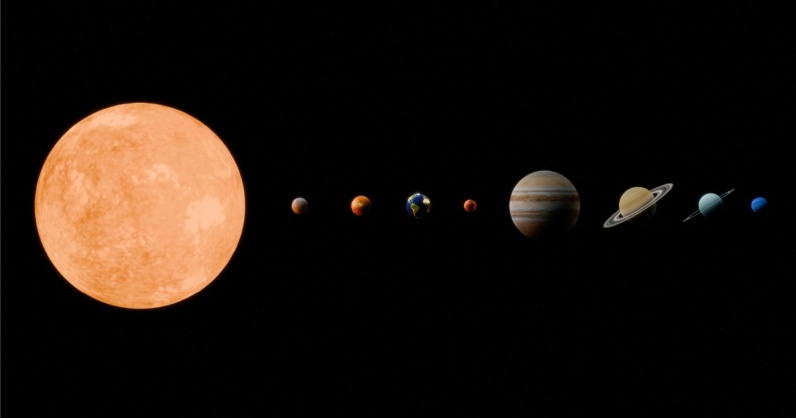
In April 2026, NASA’s Artemis II mission united the world in wonder by sending four astronauts on a recon mission around the Moon. Some of their most moving photos and observations, though, came from looking back at the Earth. This Word Stories instalment presents snapshots of words that evoke other planets while describing earthly realities.
jovial, Jovian
When the invention of the telescope revealed the largest moons of Jupiter in 1610, astronomers called them the Jovian moons. The connection between Jupiter and Jovian is not immediately clear in English, unless you know that the planet Jupiter was named for the chief Roman god known as Jupiter or Jove. In Classical Latin, his name was Jupiter. The first part of this name preserves the older name Iovis/Jovis, whose roots go all the way back to the Proto-Indo-European noun *dyews (“bright one”)—a form that lies behind words as far-flung as the Latin deus, the Greek theos and its derivative Zeus, or the Sanskrit deva (all of which mean “god”). By adding the title pater (“father”) to the name Iovis (“Jove”), Latin produced the composite name Jupiter (“Father Jove”).
The old name Jove is of course also the basis of the adjective Jovian, which first appears in English meaning “related to Jupiter/Jove” (J. Palsgrave, Lesclarcissement de la langue francoyse, 1530). The original associations were mythological, but the adjective was later used to mean “related to the planet Jupiter”—especially in describing that planet’s moons (G. Adams, Lectures on Natural and Experimental Philosophy, 1799). The related adjective jovial has a longer pedigree, and has taken a different direction.
In Late Latin, jovialis meant “pertaining to Jove/Jupiter”, and the word carried the same connotations as it evolved into the Italian gioviale, the French jovial and the English jovial. A person born under the astrological influence of Jupiter was described, for example, as having a jovial nature (T. Stanley, The History of Philosophy, 1655). Like Jovian, the capitalized form Jovial can be found in mythological contexts meaning “related to Jove” (M. Drayton, The Owle, 1604), and then in astronomical contexts meaning “related to the planet Jupiter” (R. Hooke, Micrographia, 1665). In the end, though, astrological speculation pulled jovial into a distinct new orbit. Because the influence of Jupiter was seen as bringing joy (E. Spenser, The Faerie Queene, 1590), people got into the habit of using jovial to mean “jolly” (M. Drayton, The Legend of Great Cromwell, 1607), and this derivative meaning is the only one that survives today. Modern English speakers therefore use Jovian to talk about moons and jovial to talk about moods. To see how a planet also gave us a synonym for gloomy, check out our etymological remark for saturnine.
mercurial
In ancient Rome, Mercury (Mercurius) was the messenger of the gods. The Romans named the planet Mercury for him because its apparent motion around the sky looked so rapid and changeable compared to the other planets. Thanks to this association with fast-flying movement, Mercury was also the patron god of travel and trade. It could be, in fact, that his name comes from the old Latin word merx (mercis in the genitive), meaning “merchandise”. Mercury also gave his name to the metal called mercury (Latin mercurius) in honour of its tendency to trickle around so quickly in liquid form. When it comes to the god and the planet, the name Mercurius/Mercurie/Mercury is attested as far back as Old English, but as a name for the metal, mercury is only attested later in Middle English (G. Chaucer, The Canterbury Tales, ca. 1395). The derivative adjective mercurial appears a bit later, and its career has followed a suitably lively path.
Mercurial might mean “pertaining to the god Mercury” (D. Siculus, Bibliotheca Historica, trans. J. Skelton, 1487) or “relating to the planet Mercury” (J. Gower, Confessio Amantis, 1393), as well as “relating to the element mercury” (C. Gesner, The Treasure of Euonymus, trans. P. Morwyng, 1559). The adjective mercurial might also carry the astrological significance of being “born under the influence of the planet Mercury” (G. Harvey, Pierce’s Supererogation, 1593). The most lasting connotations of the adjective are connected, though, to the ancient associations of the divine Mercury with speed and movement: to be mercurial is to be “quick and changeable”, and so writers can be found referring, for example, to a quick-witted person’s “nimble and Mercuriall wits” (J. Trapp, A Commentary or Exposition Upon All the Epistles and the Revelation of John the Divine, 1647). These are the connotations that have come to dominate common English usage. A mercurial personality is therefore lively to the point of unpredictability, and a mercurial market is a dauntingly volatile one.
plutocracy, plutocrat
The word plutocracy entered English in the 1600s, and gave rise to both the noun plutocrat and the adjective plutocratic in the 1800s. None of these words have anything to do with the dwarf planet Pluto, not least because its presence in the Solar System was unknown until astronomer Clyde Tombaugh discovered it in 1930. The source of these words is instead the ancient Greek political term ploutokratia, which evoked a system of “rule by the rich” by combining the noun ploutos (“wealth”) with the suffix ‑kratia (“form of government”).
If there is a planetary connection, it lies only in the fact that Pluto (Ploutōn), the Greek god of the underworld, is often confused with Ploutos, the Greek god of wealth—partly because of the suggestive similarity of their names and partly due to the equation of wealth with precious metals mined from the earth. And the underworld god of ancient Greek mythology is the one whose dark and hidden nature inspired the modern name of the remote and relatively mysterious dwarf planet. According to astronomical lore, an 11-year-old mythology fan named Venetia Burney suggested the name Pluto to her grandfather, who had friends with connections. It couldn’t hurt either, though, that influential people were apparently already toying with the name—and it pleased the business leader Roger Lowell Putnam, who bankrolled Lowell Observatory. In his capacity as benefactor and sole trustee of the observatory that discovered Pluto, it was Putnam who decided on the name. Chalk up another one for the plutocracy.